


Field Guide
Batting Cage Dimensions and Setup Guide
Indoor and Outdoor Sizing by Age Group, Space Requirements, and Equipment
March 27, 2026

Getting the dimensions right on a batting cage affects everything from training quality to player and coach safety. player safety to training quality. Whether you are converting gym space into a hitting facility, adding cages to an existing outdoor complex, or planning a new build from the ground up, the measurements you choose will determine how the cage performs for years to come.
This guide covers standard batting cage dimensions for both indoor and outdoor installations, recommended sizes by age group and competition level, space planning considerations that are easy to overlook, and the equipment you need to complete the setup. For related field specifications, see our Baseball Field Dimensions Guide or our Softball Field Dimensions Guide.
Standard Batting Cage Dimensions
The standard batting cage measures 70 feet long, 14 feet wide, and 12 feet high. These dimensions work for most baseball and softball programs from the high school level through college and professional training. The 70-foot length provides enough distance for regulation pitching (60 feet 6 inches for baseball, 43 feet for softball) while leaving room behind the pitcher for equipment storage, ball carts, and pitching machines.
A width of 14 feet gives both right-handed and left-handed batters a full swing arc without netting contact on the follow-through. The 12-foot height allows fly balls to reach a natural peak before the net brings them down, which matters for coaches tracking ball flight and exit angle.
Here are the standard dimensions by common cage size:
| Cage Size | Length | Width | Height | Best For |
| Full-size | 70 ft | 14 ft | 12 ft | High school, college, pro training |
| Mid-size | 55 ft | 14 ft | 12 ft | Middle school, travel ball, multi-lane facilities |
| Compact | 35 ft | 12 ft | 12 ft | Tee work, soft toss, youth clinics, limited-space facilities |
These are the standard batting cage net sizes. The total space your facility needs will be larger because of clearance requirements around the cage, which are covered in the space planning section below.
Batting Cage Dimensions by Age Group and Level
Pitching distance is the main factor that determines cage length. A cage that is too short for the level of play being practiced creates problems on both sides of the ball: batters lose reaction time needed to track pitches, and pitchers or coaches feeding the machine stand dangerously close to high-exit-velocity contact. A cage that is longer than necessary is rarely an issue. The only real downside is the loss of floor space, which is most significant in shared indoor facilities. If your facility has the room, going longer is always the safer choice.
Youth (Little League, ages 9-12). Pitching distances at this level range from 46 feet in the Major Division (most common) down to 38 feet for the youngest age groups. A 55-foot-long cage covers all of those distances comfortably and leaves a solid buffer behind the pitcher for equipment and a safety zone. A 35-foot-long cage is an option if you're using it for tee drills and soft toss, but it is too short for any live or machine pitching at regulation youth distances.
Middle school and travel ball (ages 13-14). Pitching distances jump to 54 feet at this level, and many of these players have already started preparing for the transition to 60 feet 6 inches in high school. A 55-foot-long cage is the bare minimum. A 70-foot cage is the wiser investment because it gives players sufficient space to train at the distance they are growing into, not just the one they are at today.
High school, college, and adult. The full 70-foot-long batting cage is the standard at this level. With baseball's regulation pitching distance at 60 feet 6 inches, the extra length behind the pitcher provides room for a portable mound, pitching machine, ball feeder, and a clear zone where coaches can safely observe from.
Multi-level facilities. If your facility serves more than one age group, size up to 70 feet, and skip the debate. The same cage handles a Saturday morning Little League clinic and a weekday varsity practice without any adjustment, and it accommodates players as they move up through age divisions rather than requiring a retrofit down the road.
Indoor vs. Outdoor Batting Cage Considerations
The cage dimensions stay the same whether the installation goes indoors or outdoors. What changes is how the cage is supported, how much clearance you need around it, and how you protect the surface underneath.
Indoor batting cages are mounted using either a ceiling suspension or a wall suspension cable system. Both designs allow the net to slide along the cables and retract to one end of the facility when it is not in use, freeing the floor for basketball, volleyball, or other activities. An indoor batting cage kit from CoverSports includes all suspension hardware for either configuration, and setup or retraction is a two-person job.
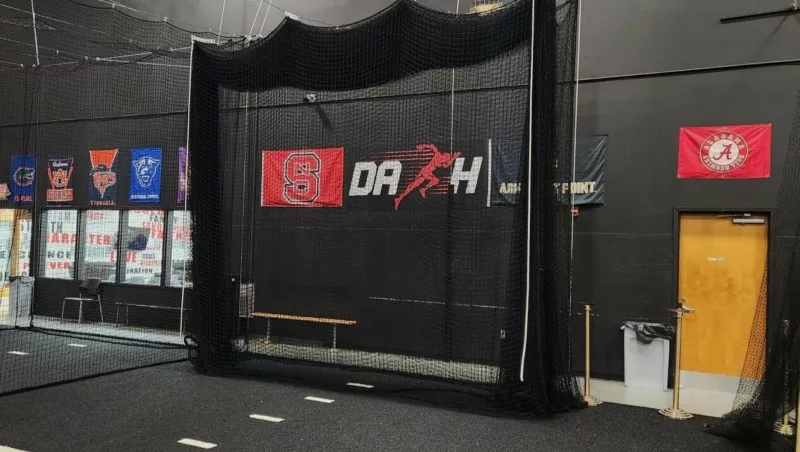
Ceiling height matters just as much as floor space when planning an indoor installation. A standard cage needs at least 12 feet of clearance, but 14 to 16 feet is preferred because the cable system and net hardware sit above the top of the net.
Floor protection is the detail that indoor facilities most often overlook. Batting practice is rough on unprotected hardwood. Cleats dig into the finish, batted balls leave dents, and dragged equipment scars the surface over time. Batting cage turf inside the cage is the most common solution for the hitting area, while gym floor covers and gym carpet tiles protect the surrounding court from foot traffic, machine wheels, and foul balls during practice.
Outdoor batting cages use a frame-and-post system set into the ground. CoverSports' outdoor batting cage system provides poles and ground sleeves for a 55-foot by 18-foot by 12-foot footprint, giving extra width compared to indoor setups since wind can push the net during use. Orient the cage so the batter is not facing into the afternoon sun. Positioning the batting end on the east side keeps the sun behind the hitter during afternoon practice.
Wind is worth planning for beyond just cage width. Adding a baseball windscreen to the sides of an outdoor cage cuts the crosswind that disrupts pitch trajectory and ball flight, giving hitters a more consistent training environment. It also provides a clean backdrop that makes the ball easier to pick up out of the pitcher's hand.
Outdoor flooring is another consideration that pays off long-term. Natural turf wears down fast inside a batting cage because foot traffic is concentrated in a small area around home plate. Artificial batting cage turf rolls create a low-maintenance surface that drains well and holds up season after season.
Batting Cage Space Requirements
The net dimensions alone do not tell you how much room you actually need. Every installation requires buffer zones around the cage for safety, player access, and net deflection when balls make contact.
Side clearance. Leave 3 to 5 feet between the net and any wall, fence, or adjacent cage. The batting cage net pushes outward on contact, and if it sits too close to a hard surface, balls can ricochet back through the mesh. For side-by-side tunnel setups, keep at least 6 inches of separation between adjacent nets for the same reason.
End clearance (pitcher's end). Allow 5 to 10 feet behind the pitcher's position for a pitching machine, ball cart, portable mound, or protective L-screen.
End clearance (batter's end). Leave a minimum of 3 feet behind the batter for a catcher or coach. If spectators will be near this end, increase the buffer to 5 feet and consider adding a CageSaver batting cage backdrop. A backdrop is a heavy-duty vinyl panel available in 22 oz. and 30 oz. weights with a printed strike zone that protects the net at its highest-impact point and gives pitchers a visual target.
Ceiling clearance (indoor only). Leave 2 to 4 feet between the top of the net and the ceiling for the cable system and mounting hardware. If your facility has exposed beams, ducts, or sprinkler heads, map those obstructions out before finalizing the cage position.
How much space do you need for a batting cage? The table below shows the total room dimensions required for each standard cage size, including clearance and buffer zones.
| Cage Net Size | Tight Fit (Min. Clearance) | Recommended (Full Clearance) |
| 70 ft x 14 ft x 12 ft | 80 ft x 22 ft x 14 ft | 85 ft x 24 ft x 16 ft |
| 55 ft x 14 ft x 12 ft | 65 ft x 22 ft x 14 ft | 70 ft x 24 ft x 16 ft |
| 35 ft x 12 ft x 12 ft | 45 ft x 20 ft x 14 ft | 50 ft x 22 ft x 16 ft |
If you are working with limited space, measure the longest uninterrupted dimension of the room and subtract 10 to 15 feet. That gives you the maximum cage length that will fit comfortably.
What Equipment Do You Need for a Batting Cage
The cage frame and net are the obvious foundation, but a complete batting cage setup includes several additions that protect your facility, improve the training experience, and extend the life of the installation.
Netting. Batting cage nets are sold separately from the hardware kit because the gauge and material need to match the level of play. Heavier gauges like #42 and #60 nylon are built for high-velocity contact from pitching machines and older players. Lighter gauges like #21 and #36 work for coach-pitch and tee drills at the youth level. CoverSports offers batting cage replacement nets in multiple sizes and gauges to match your program's needs.
Turf. Artificial turf inside the batting cage eliminates grass maintenance for outdoor installations and protects hardwood for indoor ones. Batting cage turf is sold in 15-foot-wide rolls that you cut to the length of your cage. It drains well, holds up to daily cleat traffic, and keeps the hitting surface consistent all season.
Home Plate Mat. A home plate mat anchors the batter's position and gives coaches a consistent visual reference for working on stance, plate coverage, and swing mechanics.
Backdrop protector. The pitcher's end of the cage takes the most punishment from batted balls. A CageSaver batting cage backdrop absorbs that impact and extends the life of your netting significantly. It is available in standard and custom team colors with a printed strike zone.
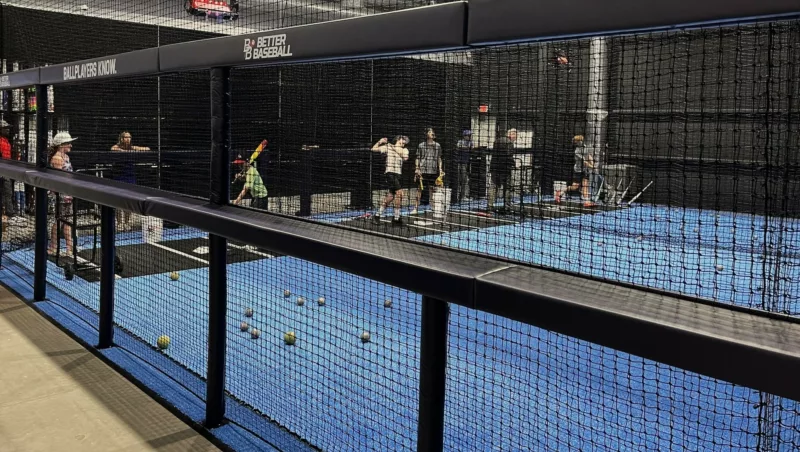
Padding. Any hard surface within the buffer zone should be padded. Indoors, that means walls, columns, and exposed beams near the cage. Custom gym wall padding and column padding protect athletes during drills and reduce the risk of balls ricocheting off hard surfaces back into the playing area. Outdoors, custom fence rail and post padding wraps the cage frame's structural posts to absorb contact and cut down on dangerous ricochets off exposed steel. Rail padding also gives coaches a cushioned surface to lean against while observing from just outside the cage, turning a safety feature into a practical one. If your facility includes a full baseball or softball diamond, our protective padding for your facility guide covers outfield wall padding, backstop padding, and fence top protection beyond the cage.
Batting Cage Dimensions for Softball
Softball batting cages use the same width and height as baseball cages. The difference is in the length, which can be shorter because the pitching distance is shorter (43 feet from the rubber to home plate at the college and high school level, compared to 60 feet 6 inches in baseball).
A 55-foot cage works well for dedicated softball training. The 43-foot pitching distance leaves 12 feet behind the pitcher, which is enough room for a machine and ball cart. Programs that share cages between baseball and softball teams should stick with the full 70-foot length so the space serves both sports without adjustment.
One consideration specific to softball: the pitching delivery. Softball pitchers use a windmill motion that requires more lateral arm clearance than an overhand baseball delivery. The standard 14-foot width handles this comfortably, but coaches who run simultaneous pitcher-batter drills (with the pitcher inside the cage) should confirm the width works for their tallest pitcher's full windmill extension.
For complete softball facility planning, including base paths, fence distances, and backstop placement, see our Softball Field Dimensions Guide.
Planning Your Installation: A Step-by-Step Checklist
Whether you are adding a single cage to an existing gym or building a multi-lane outdoor complex, this checklist covers the key planning steps.
- Measure the available space. Record length, width, and ceiling height (for indoor) or overhead obstructions (for outdoor). Note the location of any columns, beams, ducts, sprinkler heads, and electrical outlets.
- Select the cage size. Match the cage length to the highest level of play that will use it. When in doubt, go longer. A 70-foot cage works for every age group; a 55-foot cage cannot be stretched later.
- Choose indoor or outdoor mounting. Indoor installations use ceiling or wall suspension cable kits. Outdoor installations use ground-set poles and sleeves. CoverSports offers both as complete hardware kits.
- Plan the flooring. Indoor cages over hardwood need turf inside the cage and floor protection (GymGuard covers) outside the cage. Outdoor cages benefit from artificial turf over the hitting area to prevent grass wear.
- Select the netting. Match the net gauge to the expected ball speed. High school and college programs using pitching machines should use #42 or heavier netting. Youth programs using coach-pitch or tee drills can use lighter gauges.
- Add protective equipment. Map any hard surfaces within the clearance zone and plan padding. Add a CageSaver backdrop to the pitcher's end. For indoor setups, assess whether gym wall padding is needed on adjacent walls.
Ready to plan your batting cage installation? Get a Free Quote or call (800) 445-6680 to discuss dimensions, configuration, and custom options with our team.
CoverSports
5000 Paschall Avenue
Philadelphia, PA 19143, USA

